
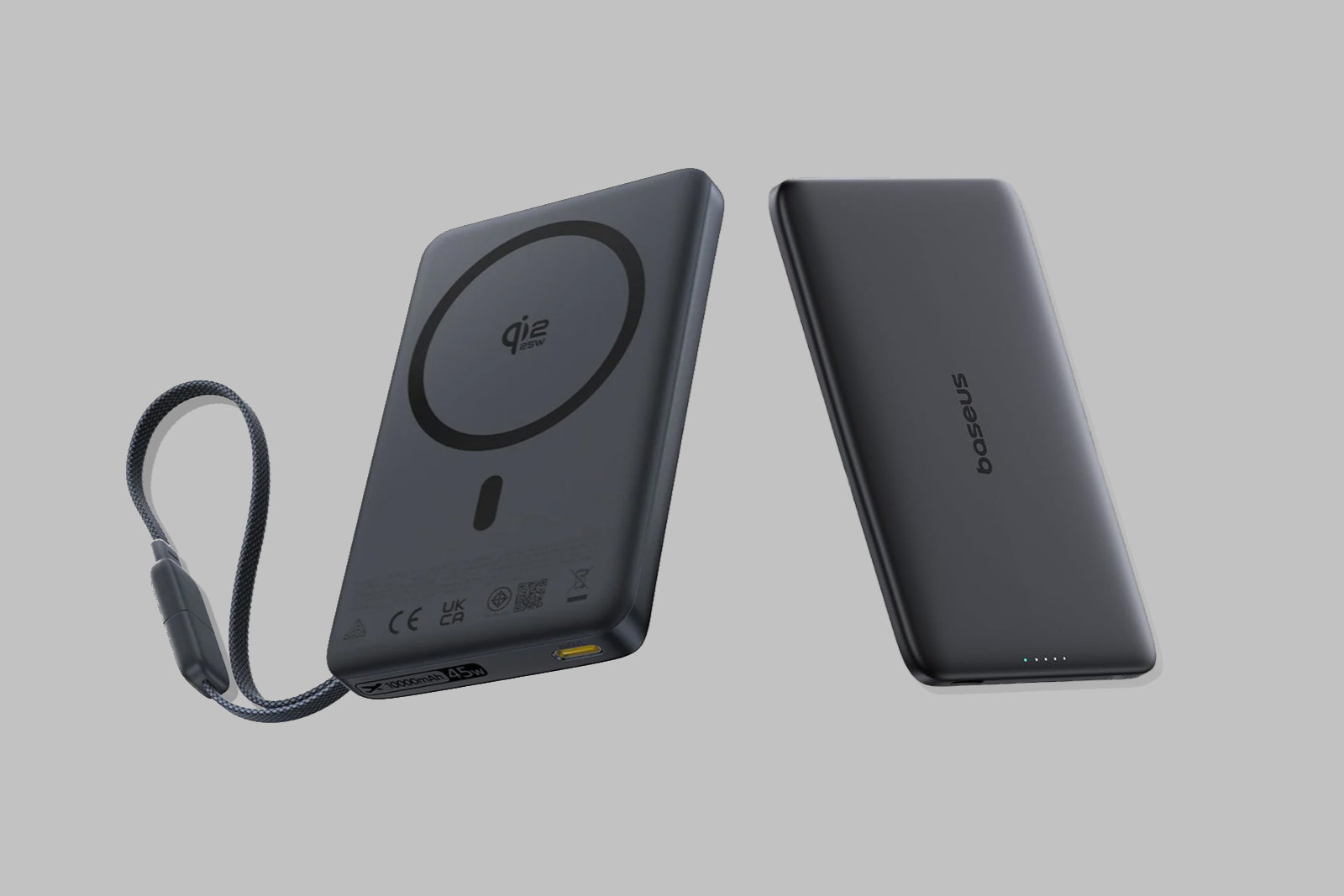
I’ve gone through my fair share of battery packs over the years. I still remember when I bought a 20,000mAh Aukey pack. That thing weighed like a brick and was very impractical to bring with you. I’ve watched these packs shrink down over the years, from the Anker Zolo 10,000mAh series to the Anker 621 magnetic battery pack.
When I set out to find the best travel battery, I had a few criteria: it had to be as thin and small as possible while still packing in a large capacity, and I wanted Qi wireless charging with magnets. My Samsung Galaxy Z Fold7 was already set up for this. After searching through the catalogs of Anker, Ugreen, and various others, I settled on two.
Disclosure: I am not affiliated with Baseus and did not receive any monetary compensation or free products for this review. My opinions are based solely on my personal experience. There is an affiliate link at the bottom of this review. If you choose to use it, I may receive a small commission at no additional cost to you.
Baseus PicoGo Ultra-Slim 5K: thin and light

The Baseus PicoGo Ultra-Slim is an insanely thin 5,000mAh battery. It measures 3.9 x 2.6 x 0.36 inches and comes in at 0.3 inches thick and 3.8oz (108g), so it’s easy enough to toss into a backpack or purse for trips. Charging is simple thanks to the built-in Qi wireless charging, though the one downside is that it maxes out at 7.5W, which is fairly slow. The built-in USB-C port supports 20W charging, a much faster option if you need a boost in a pinch.
The real appeal is being able to drop this onto my phone without thinking about it. And because it’s so thin, you barely notice it’s there. The body is an aluminum shell with a soft silicone panel on the side that touches your phone, and there’s a single small LED on the edge that shows charge status at a glance rather than a full percentage readout. Each color comes in a polished or matte finish: cosmic black, natural titanium, and nebula pink. It costs $50 MSRP, though it’s regularly on sale for around $27. It also carries CCC certification, which you’ll need if you want to bring it on a plane in China.
For my Samsung Galaxy Z Fold7 (4400mAh), I get about an extra full charge with the battery pack.
Baseus PicoGo AM52: thin, light and fast with a built-in cable

If you’re looking for something with more capacity, the Baseus PicoGo AM52 is a great contender. This one charges your phone quickly, supporting Qi2.2 wireless charging at up to 25W and 45W wired charging through the built-in USB-C cable. It’s still MagSafe compatible; you can pop it onto the back of your phone for a quick recharge.
The case is mostly aluminum, which runs slightly warm to the touch during charging (a byproduct of it dissipating heat well), with the MagSafe side finished in soft, non-slip silicone so your phone doesn’t get scratched. There’s a slightly protruding pill-shaped power button on the right side of the pack and a USB-C port on the bottom. The built-in USB-C cable doubles as a nylon-braided strap. Near the bottom of the aluminum casing are five dots: four that signal charge level, plus a fifth dot to indicate charging status.
The most impressive thing here is that despite being a 10,000mAh pack, it’s still remarkably small and thin: about 4.1 x 2.6 x 0.63 inches and roughly 7.4oz (211g), only a bit larger than a credit card and noticeably thinner than my old Anker Zolo 10,000mAh battery pack. It slides into a jacket pocket or the front sleeve of a laptop bag without adding much bulk. This one runs $80 MSRP but regularly discounts to around $65.
For my Samsung Galaxy Z Fold7 (4400mAh), I get two extra full charges with this battery pack with a little bit left over.
Bottom line

These two battery packs are what I carry daily. If you want the thinnest possible option for topping off your phone throughout the day, go with the PicoGo Ultra-Slim 5K. If you want more capacity and faster charging in a package that’s still slim enough to forget it’s in your bag, the PicoGo AM52 is the better call. If you’re like me, you’ll end up buying both: one to quickly throw onto the back of my phone as I rush through the airport, the other for heavier charging sessions when I’m in the lounge. I pretty much have zero worry that my phone will die during a long day of exploring a new city.
I also tried the Baseus PicoGo Air, which is technically 0.03 inches thinner and 0.1oz lighter than the Ultra-Slim, but I can’t recommend it. The magnet is too weak and easily falls off. It is also wider and taller than the Ultra-Slim despite being marketed as thinner. The cost is more too, $70 MSRP versus $50 for the Ultra-Slim. If you’re deciding between the two, skip the Air.
If you want to pick up either of these, here are my (Amazon) affiliate links for the Baseus PicoGo Ultra Slim 5k and Baseus PicoGo AM52. It costs you nothing extra and helps keep this site going. Happy travels ✌
Leave a Reply